

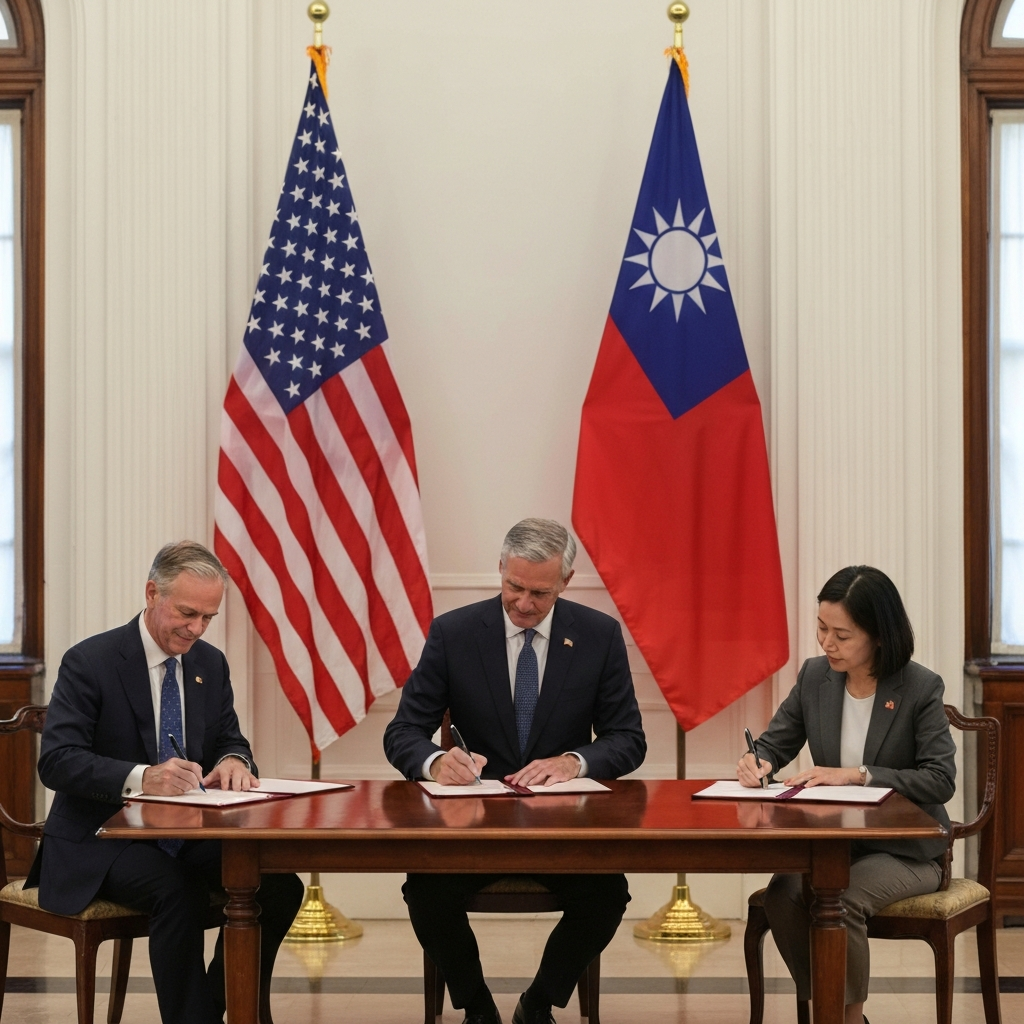
In recent months, the relationship between the United States and Taiwan has seen significant developments, particularly in the realms of trade and defense. These changes have profound implications for Taiwan’s economy and its position on the global stage.
Trade Agreements and Economic Cooperation
On February 12, 2026, the U.S. and Taiwan finalized the Agreement on Reciprocal Trade (ART), a landmark deal aimed at enhancing economic ties. Key aspects of the agreement include:
- Tariff Reductions: The U.S. agreed to reduce tariffs on Taiwanese imports to 15%, down from the previous 20%. In return, Taiwan committed to eliminating or lowering tariffs on nearly all U.S. goods. This move is expected to boost bilateral trade and provide mutual economic benefits.
- Increased Purchases of U.S. Goods: Taiwan plans to significantly increase its purchases of U.S. products from 2025 through 2029. This includes $44.4 billion worth of liquefied natural gas and crude oil, $15.2 billion worth of civil aircraft and engines, and $25.2 billion worth of power grid equipment and generators.
- Semiconductor Investments: Taiwanese companies have pledged $250 billion in direct investments in U.S. semiconductor manufacturing, energy, and AI sectors. An additional $250 billion in credit guarantees will support these expansions. Notably, Taiwan has emphasized that its most advanced semiconductor technologies will remain domestically produced, ensuring the island’s continued leadership in this critical industry.
Defense Cooperation and Regional Stability
Alongside economic initiatives, defense cooperation between the U.S. and Taiwan has intensified. In December 2025, the U.S. approved a record-high $11 billion arms package to Taiwan, underscoring a commitment to the island’s security. This move is part of a broader strategy to enhance Taiwan’s defense capabilities amid regional tensions.
Furthermore, U.S. lawmakers recently reaffirmed the Taiwan Relations Act on its 47th anniversary, highlighting its continued role as the foundation of U.S.–Taiwan relations and a key pillar of Indo-Pacific stability. They emphasized support for Taiwan’s security, democracy, and economic development, reiterating their commitment to maintaining support for Taiwan.
Implications for Taiwan
These developments present both opportunities and challenges for Taiwan. Economically, the trade agreements promise increased market access and investment, potentially spurring growth and innovation. However, the emphasis on maintaining domestic production of advanced technologies reflects a cautious approach to preserving Taiwan’s strategic advantages.
On the defense front, enhanced cooperation with the U.S. serves as a deterrent against regional threats but may also escalate tensions with neighboring countries. Taiwan’s leadership continues to navigate these complex dynamics, aiming to bolster security while promoting regional stability.
As these agreements unfold, their long-term impact on Taiwan’s economy and security landscape will become clearer. For now, they signify a deepening partnership between Taiwan and the United States, with significant implications for the region.