

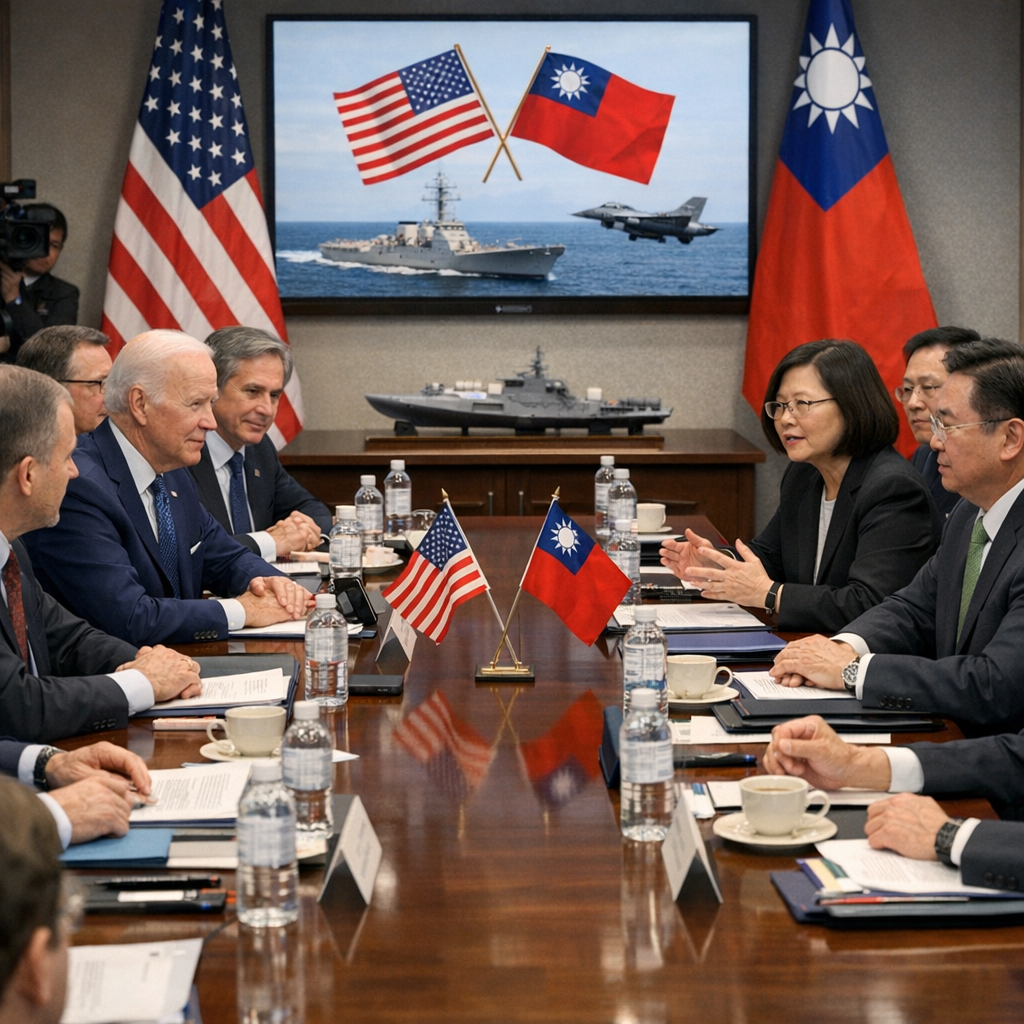
Recent developments have significantly influenced the multifaceted relationship between the United States and Taiwan, encompassing trade agreements, defense cooperation, and the semiconductor industry.
Trade Agreements and Economic Collaboration
In early 2026, the U.S. and Taiwan finalized a reciprocal trade agreement aimed at strengthening economic ties. This accord reduced U.S. tariffs on Taiwanese imports from 20% to 15%, while Taiwan committed to eliminating or lowering tariffs on nearly all U.S. goods. Additionally, Taiwan pledged to increase purchases of U.S. products, including $44.4 billion worth of liquefied natural gas and crude oil, $15.2 billion worth of civil aircraft and engines, and $25.2 billion worth of power grid equipment and generators, marine, and steelmaking equipment from 2025 through 2029. This agreement underscores the deepening economic partnership between the two entities.
Defense Cooperation and Arms Sales
Defense collaboration remains a cornerstone of U.S.-Taiwan relations. In May 2026, Taiwan expressed concern over a delayed $14 billion U.S. weapons package, initially approved by American lawmakers. The delay was attributed to the U.S. administration’s reassessment of munitions stockpiles amid global military commitments. Taiwanese officials emphasized the importance of consistent arms deliveries to maintain peace in the Indo-Pacific region, especially in light of expanding Chinese military activities.
Semiconductor Industry and Strategic Investments
The semiconductor sector plays a pivotal role in the U.S.-Taiwan relationship. In January 2026, both parties signed a historic trade deal to bolster U.S. semiconductor manufacturing. Taiwanese enterprises committed to investing at least $250 billion directly into building and expanding advanced semiconductor, energy, and artificial intelligence production in the U.S. An additional $250 billion in credit guarantees was pledged to support the establishment and expansion of the full semiconductor supply chain and ecosystem in the U.S. This strategic partnership aims to enhance supply chain resilience and technological leadership.
However, Taiwan has firmly rejected U.S. calls to transfer 40% of its semiconductor production capacity to the United States. Taiwanese authorities emphasized that the island’s semiconductor ecosystem cannot simply be relocated and that domestic industry, including key players like TSMC and UMC, will continue expanding at home. While TSMC is investing in overseas facilities, such moves are expected to progress only in tandem with domestic growth.
Geopolitical Considerations
The evolving U.S.-Taiwan relationship occurs against a backdrop of complex geopolitical dynamics. Taiwan’s strategic position and its advanced semiconductor industry make it a focal point in U.S.-China relations. The U.S. continues to navigate its commitments to Taiwan while managing its broader relationship with China, striving to maintain regional stability and economic security.
In summary, the U.S.-Taiwan relationship is characterized by deepening economic ties, ongoing defense cooperation, and strategic investments in critical industries. These developments reflect a shared commitment to mutual prosperity and security in a rapidly changing global landscape.